How to Build Trust With a New Client: The First Deposit
In 1971, the psychologist Dennis Regan ran an experiment that marketers have been quietly exploiting ever since.
Subjects came to a lab, supposedly to rate paintings, alongside another participant named Joe. Joe was a plant. In half the sessions, Joe slipped out during a break and came back with two bottles of Coke: one for himself, one for the subject, unasked. In the other half, he came back empty-handed.
Later, Joe asked everyone the same favour: would you buy a few raffle tickets from me? The subjects who had received the Coke bought roughly twice as many tickets as the ones who had not.1 The Coke cost a dime. The average payback was several times that.
The detail worth remembering: among the people who got the Coke, it barely mattered whether they liked Joe. The unasked favour did the work that charm could not.
Sociologists had already named the force Regan measured. Alvin Gouldner, surveying every culture anthropology had records for, called reciprocity a universal norm: humans everywhere feel a pull to return what they receive.2 Robert Cialdini later documented how deeply it runs, even with tiny, unrequested gifts.3
A relationship opens the way an account opens: with a deposit. Most professionals open with a withdrawal, and then wonder why nobody banks with them.
What counts as a deposit
Not all giving qualifies. A deposit has three properties, and the third is the one people miss:
- It is specific to them. A blog post is content. A note that says, this clause in the new regulation affects firms with your structure, is a gift.
- It costs you something. Ten minutes of real thinking, an introduction that spends your social capital, a finding from your own work.
- It is useful whether or not they ever hire you. If the value only unlocks after a purchase, it is a brochure, not a deposit.
And the withdrawals? A pitch. A proposal. A request for a referral. And the most common one, dressed as politeness: just checking in — which asks for their attention and pays nothing for it.
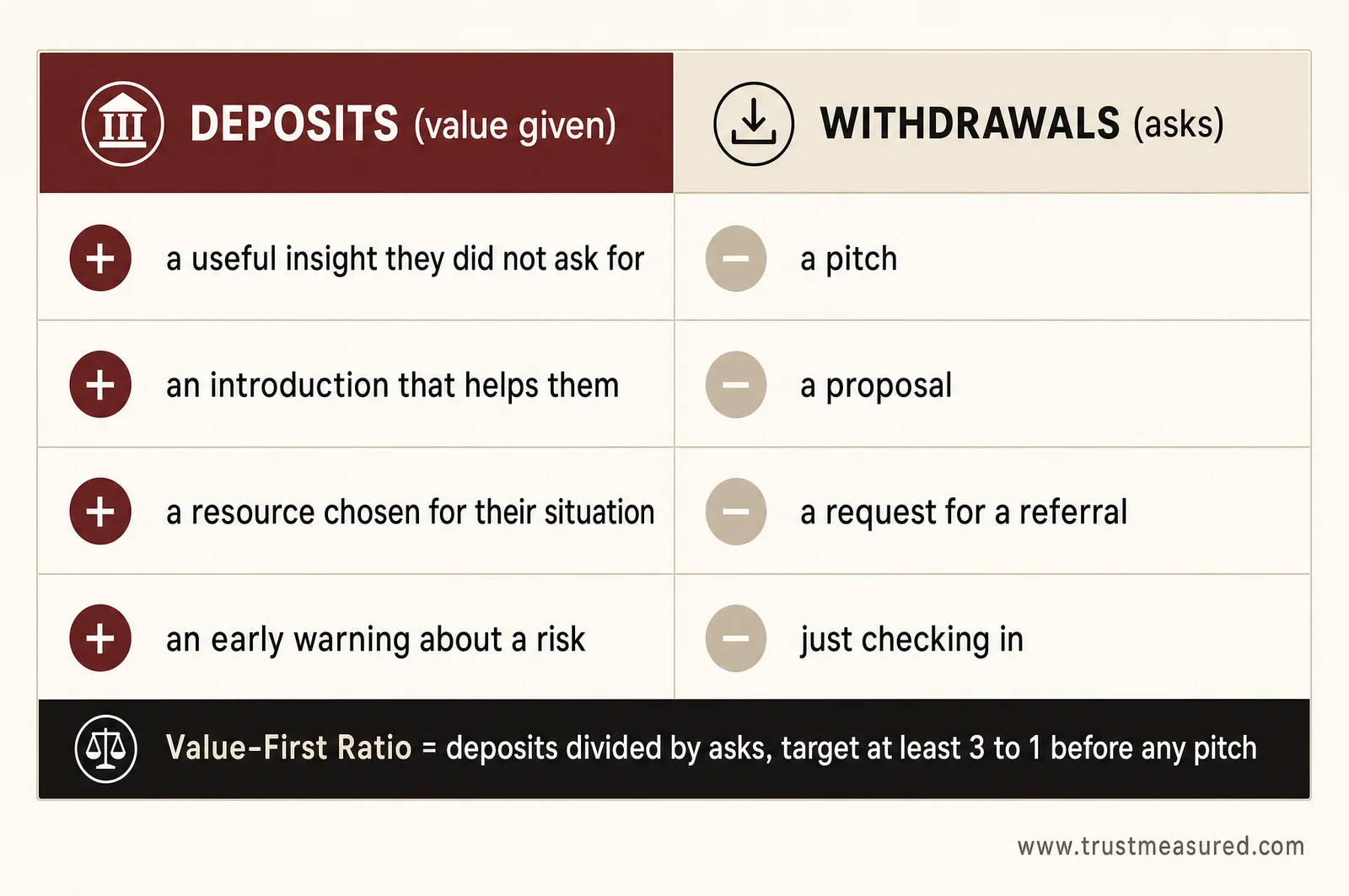 The opening ledger. One column builds the relationship. The other spends it.
The Value-First Ratio
Value-First Ratio = deposits made ÷ asks made
Target: at least 3 to 1 before any pitch.
Why three? Honest answer: three is my recommended practice, not a derived constant.
The reasoning behind it is the negativity asymmetry — bad is stronger than good, so events that cost a relationship are weighed more heavily than events that build it. That finding is robust. What it does not do is produce the number three, and I want to be careful not to dress a rule of thumb in a lab coat.
Two things it is easy to overstate here, so let me not. An ask is not a trust-destroying event — a well-timed, relevant proposal is often the most useful message you will ever send someone, and a professional who never asks for anything reads as either uninterested or unserious. And reciprocity research shows a gift raises compliance; it does not show that asking without one causes harm.
What three does is give you a working margin. It is high enough that you are demonstrably useful before you are transactional, and low enough to actually sustain. If you prefer two, use two. The ratio matters far less than the fact that you are counting at all — almost nobody is, and almost everybody's real number turns out to be well under one.
A labelled hypothetical, to make it concrete. Imagine a bookkeeper who reads that a prospect's company just changed legal structure. She sends five lines: the new filing deadline that now applies, the penalty for missing it, nothing else. No pitch, no link to her services, no calendar invite. Fifteen minutes of her attention, unasked.
That is a spark. When that company needs a bookkeeper, there is no shortlist.
Do this now: the 30-day ledger
15 minutes.
- List every first-touch or early-relationship message you sent in the last 30 days.
- Mark each one D for deposit or W for withdrawal. Be harsh: just checking in is a W.
- Divide D by W.
Below 3, your sparks are withdrawals wearing friendly subject lines.
Going forward: one deliberate deposit per working day, 15 minutes, no ask attached. Five sparks a week is 250 a year. No ad budget does that.
Where this sits
The Spark is the first stage of the Resonance Pathway — the road a stranger travels to becoming a client who would never replace you. There are seven stages in total, each raising specific variables in the Trust Singularity Score, and each with its own metric.
But the ratio above is where it starts, and it is the one you can begin tracking tomorrow morning with nothing but your sent folder.
Start here: Score a client relationship with the free Trust Singularity Score calculator — four numbers, ten minutes, and you will know which relationship is quietly slipping.
References
The whole system, not just the argument
These essays are the opening chapters. The complete book adds the Resonance Pathway, the monthly dashboard and the 90-day plan that installs all of it, with two bonus guides, for $7.
See what is inside Trust Measured