Can Trust Be Measured? The Trust Singularity Score
Two professionals work in the same city, in the same economy, under the same AI storm. One has not advertised in years. The other one is smarter.
The first is a contractor. Call him Imran. His proposals are detailed, his timelines are explicit, and when something goes wrong on a site, his clients hear it from him the same day, with a recovery plan attached. He remembers that a client's daughter just started university. He is booked eighteen months out, charges above market rate, and has not advertised in years.
The second is a consultant. Call her Dania. She is, and I mean this precisely, smarter than Imran. Better degrees, sharper analysis, deeper expertise. She speaks in frameworks, sends the same polished template to every client, and answers questions when asked but rarely before. She is permanently hunting for new clients, competing on price, and quietly burning out.
Imran and Dania are composites, built from patterns I have watched repeat across hundreds of service providers for a decade. Every detail is typical. No detail is a specific person.
Conventional career logic cannot explain these two. The more skilled professional is losing.
The reason is that clients grade the evidence of your work, not the work itself — they cannot judge the work, so they judge what they can see. This article turns that into a number.
The science under the score
Two models anchor everything that follows.
The first is the standard model of trust in the research literature: when we decide whether to trust someone, we judge their ability, their benevolence, and their integrity.1
The second comes from David Maister, Charles Green, and Robert Galford, whose book The Trusted Advisor distilled decades of professional-services experience into a single expression:2
Trust = (Credibility + Reliability + Intimacy) ÷ Self-Orientation
Read the denominator twice. Credibility, reliability, and closeness all build trust on top of the line. But everything is divided by self-orientation: the degree to which you appear to be in this for yourself. Let that number grow and it does not matter how brilliant the numerator is. The fraction collapses.
Both of these have been operationalised before. Maister, Green and Galford's own Trust Quotient assessment turns their equation into a questionnaire, and it is a good one. It profiles you — your habits as a trusted advisor, across all your relationships.
That is the distinction worth being precise about, because it is the only real claim I am making for the Trust Singularity Score. The TQ tells you what kind of advisor you are. The TSS scores one named client, on four delivery behaviours that client could have observed, inside a fixed 60-day window. It is a per-relationship instrument rather than a per-person one, which is what makes it something you can run monthly across a book of clients and watch move.
Different questions, both useful. If you want a profile of yourself, take the TQ. If you want to know which of your eleven clients is quietly slipping, keep reading.
The Trust Singularity Score
TSS = (Clarity × Consistency × Proactivity × Personalization) ÷ 100
Each variable scored 1 to 10, per client. Result: 0.01 to 100.
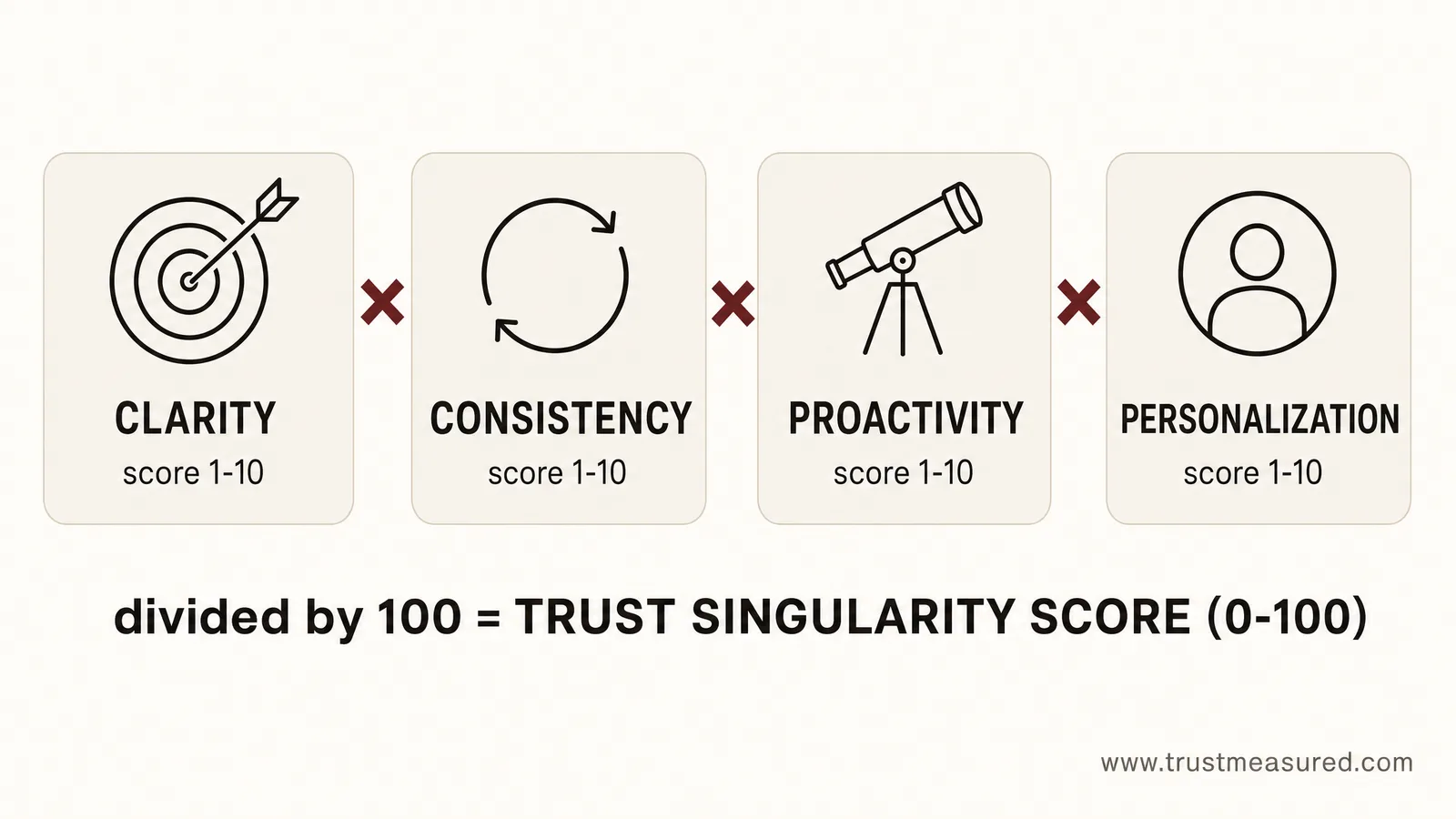 The Trust Singularity Score. Four observable behaviours, multiplied.
Four variables. Each is an observable behaviour, not a feeling. Each maps onto the established science: Clarity and Consistency carry credibility and reliability. Proactivity and Personalization carry benevolence and intimacy. And self-orientation is hiding in the scoring rubric of all four.
| Variable | A 3 looks like | A 7 looks like | A 10 looks like |
|---|---|---|---|
| Clarity | Client often asks what is happening and when | Client can describe status, but checks details with you | Client could repeat plan, status, and next step to their boss from memory |
| Consistency | Promises slip without warning; cadence is moody | Mostly on time; occasional silent misses | Every promise kept or renegotiated before the deadline, for months |
| Proactivity | Client initiates nearly every exchange | You initiate updates, but bad news still arrives late | Client hears everything from you first, especially problems |
| Personalization | Same template to everyone; generic greetings | Some tailoring to industry and role | Nothing you send could have been addressed to anyone else |
Two scoring rules:
- Score the last 60 days, not your reputation in general. Trust is a moving average and old glory decays.
- Score what the client experienced, not what you intended. Intentions are invisible.
Why multiply, when adding feels kinder
Notice the formula multiplies. This is not styling. It is the mathematical claim at the centre of the whole system, and it comes from two of the most robust findings in psychology.
Paul Slovic, studying how trust in institutions is built and destroyed, documented what he called the asymmetry principle: trust-destroying events are noticed more, weighed more heavily, and remembered longer than trust-building events.3 Roy Baumeister and colleagues reviewed hundreds of studies across every domain of life and titled the pattern plainly: bad is stronger than good.4
Addition cannot represent that asymmetry. Multiplication can.
Watch what each model says about the same professional, scoring 9, 9, 9 and 1:
- Additive model: 9 + 9 + 9 + 1 = 28 out of 40. Seventy percent. A solid B minus. No alarm.
- Multiplicative model: 9 × 9 × 9 × 1 = 729 ÷ 100 = 7.29 out of 100. Sirens.
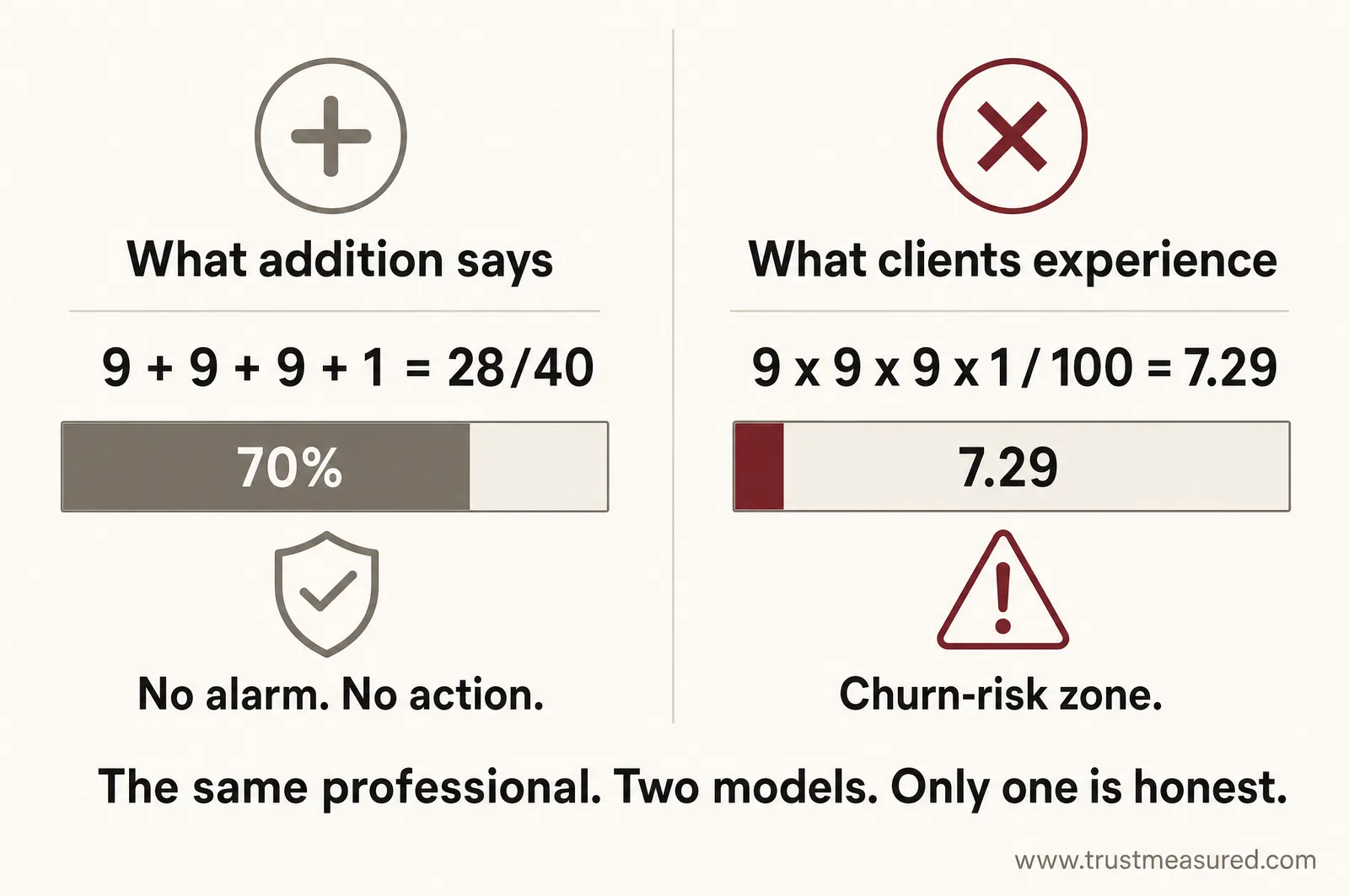 The same professional, two models. Clients experience the right-hand one.
One near-zero behaviour does not dent client trust. It collapses it. The formula that cannot collapse is the formula that lies to you.
Every professional reading this knows a brilliant colleague whose one weak variable — usually Proactivity — quietly caps their career. The additive worldview tells that person they are fine on average. Clients do not experience averages.
Be clear about what the research does and does not license here. Slovic and Baumeister establish the asymmetry — that bad weighs more than good. They do not prescribe multiplication, they do not specify four variables, and they say nothing about dividing by 100. Multiplying is my way of building their finding into something calculable; the choice of these four behaviours comes from a decade of watching which ones clients actually comment on. The evidence supports the shape of the model. The model itself is mine, and you should hold it to a practitioner's standard rather than a paper's.
The four zones
Every TSS lands in one of four zones, and each zone predicts behaviour you can verify against your own client history.
| Zone | Score | What the client does |
|---|---|---|
| Churn Risk | 0 – 25 | Comparing alternatives |
| Transactional | 25 – 50 | Stays while convenient |
| Trusted | 50 – 75 | Renews, forgives, listens |
| Singularity | 75 – 100 | Refers, pays premium, will not leave |
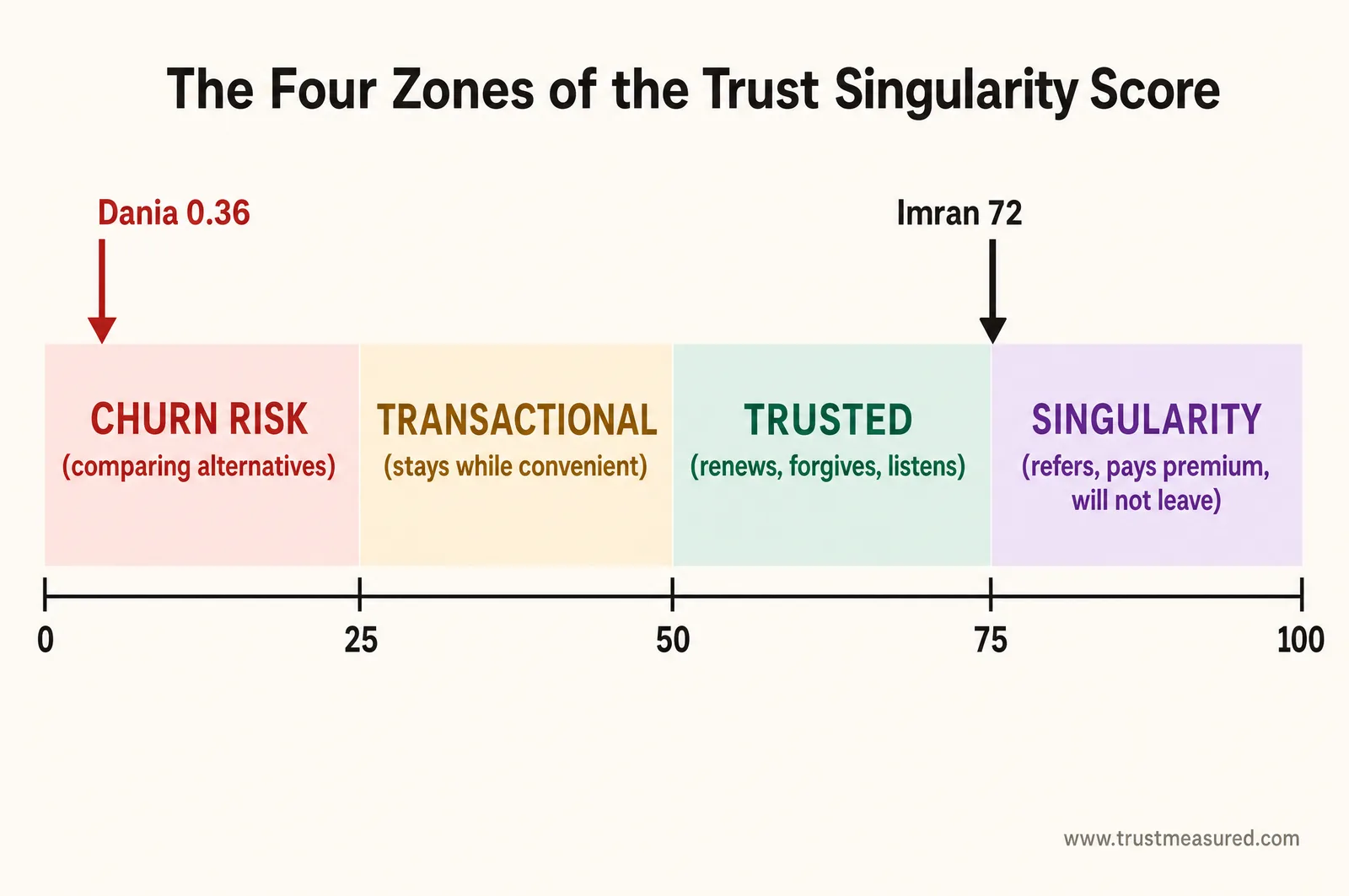 The four zones, with Imran and Dania placed where their behaviour put them.
A necessary caveat about these bands. They are interpretive, not predictive. The boundaries at 25, 50 and 75 are round numbers chosen to divide a scale, and the descriptions are my read of a pattern across a decade of practice — not a finding validated against renewal or referral data. A client in Churn Risk is not forecast to leave. The score is telling you that the behaviours known to hold relationships together are largely absent from this one. Treat a band as a prompt to go and look, never as a prediction of what will happen.
Note also that the scale is an index, not a percentage. Four sevens score 24.01, not 70. Multiplying four numbers compresses everything that is not close to excellent, which makes the middle of the range far harsher than a grade would be. A first score is a baseline for comparison — this client against that one, and this client now against the same client in sixty days — not a mark out of a hundred.
Now score the two professionals from the start.
| Clarity | Consistency | Proactivity | Personalization | TSS | |
|---|---|---|---|---|---|
| Imran, contractor | 10 | 10 | 9 | 8 | 72 |
| Dania, consultant | 3 | 6 | 2 | 1 | 0.36 |
Imran sits high in the Trusted zone, brushing Singularity. Dania, with twice his expertise, scores effectively zero.
Her ability never enters the formula, and that is the formula working correctly. Ability is the price of admission. It buys you the right to be evaluated on the four variables; it cannot substitute for them.
And Dania does not need five improvements. She needs one. Her Personalization score of 1 is the collapsed multiplier — raising it from 1 to 5 multiplies her entire score fivefold.
That is the practical gift of the multiplicative model. It tells you where the leak is, and it shows that raising the worst variable pays more per point than polishing the best one. Fix the lowest number first is the rule I would give almost anyone.
But it is a rule about the arithmetic, not about your business, and it is worth saying where it stops. Points are not equally expensive. If Personalization is a 3 and raising it means rebuilding how you write every message, while Consistency is a 4 and raising it means one recurring calendar reminder, do the calendar reminder — you will bank the gain this week instead of intending it for a quarter. The formula ranks leverage. Only you can rank effort.
The hidden denominator
Maister's equation divides by self-orientation, and the TSS seems to have no denominator. Look closer. Self-orientation is what a low score on any variable is made of.
Vague updates serve your convenience. Broken cadences serve your schedule. Reactive communication serves your workload. Template messages serve your efficiency.
Every low score is a place where the client can see that something mattered more to you than they did.
Do this now: the convenience audit
15 minutes.
- Write down the five habits that shape what your clients experience: how often they hear from you, how fast you respond, what your updates look like, who usually initiates contact, and how bad news travels.
- For each habit, ask one question: if my best client had designed this habit, would it look the way it looks now?
- Count the mismatches.
Each mismatch is self-orientation made visible, and each one maps directly onto one of the four variables. Most professionals find three or more. You do not need to fix them today. You need to know which variable each one is quietly dividing.
Score your five
Now the exercise everything has been building toward, and the baseline for everything that follows.
20 minutes.
- List your five most important clients by revenue or strategic value.
- Score each variable 1 to 10, using the rubric above and the last 60 days only.
- Multiply, divide by 100, and write the TSS next to each name.
- Circle the lowest variable for each client. That circle is your work.
| Client | Clarity | Consistency | Proactivity | Personalization | TSS |
|---|---|---|---|---|---|
| 1. | |||||
| 2. | |||||
| 3. | |||||
| 4. | |||||
| 5. |
Three predictions before you start. At least one score will be lower than you expected, and it will sting. The client you have been vaguely worried about will turn out to sit in the Transactional zone, and now you will know why. And your highest-scoring client is the one who last referred someone to you. The formula knew.
Be ruthless with yourself here. A generous score is a lie you are telling about your own business, and the only person it deceives is you.
Do the arithmetic for me → Score a client with the free Client Trust Score calculator — sliders, live score, and a specific next step for your weakest variable.
What this measures, and what it does not
An instrument that will not say what it misses is a sales pitch. So, plainly:
What it measures. Four communication behaviours, over sixty days, for one named client, as scored by you.
What it leaves out. The quality of your actual work. Price and contract terms. Whether your client's budget was just cut, whether their strategy changed, and whether the person who hired you still works there. A relationship can end at 80 for reasons this instrument never sees, and a mediocre score can persist for years in a client who simply cannot be bothered to switch.
What it assumes. That these four behaviours are the ones clients read, that sixty days is the right window, and that the four multiply rather than combine some other way. The first is well supported by the credence-goods literature. The second and third are practitioner's judgement, and I would revise either if the evidence went against them.
Its biggest weakness is that it is self-scored, so it inherits your blind spots exactly where you can least afford them. The single most useful thing you can do with the TSS is hand the four scales to a client and ask them to score you. The gap between their number and yours is almost always more informative than either number alone.
What a baseline does not give you
You now have a baseline. What you do not yet have is a method for moving the numbers, and scores do not move because you want them to.
They move stage by stage, along a path every client relationship travels: from first contact, to first purchase, to partnership, to advocacy. That path is the Resonance Pathway. It has seven stages, each one raises specific variables, and each one has its own metric.
It begins, as everything begins, with a spark.
Next: How to build trust with a new client — the first deposit, and the 3-to-1 ratio that has to come before any ask.
References
-
Mayer RC, Davis JH, Schoorman FD. An integrative model of organizational trust. Acad Manage Rev. 1995;20(3):709-34. ↩
-
Maister DH, Green CH, Galford RM. The Trusted Advisor. New York: Free Press; 2000. ↩
-
Slovic P. Perceived risk, trust, and democracy. Risk Analysis. 1993;13(6):675-82. ↩
-
Baumeister RF, Bratslavsky E, Finkenauer C, Vohs KD. Bad is stronger than good. Rev Gen Psychol. 2001;5(4):323-70. ↩
Score a client relationship in ten minutes
Four numbers, one formula, and a score out of 100 for a client you already have. Free, no sign-up, no email required.
Open the free Client Trust Score calculator