What Clients Are Actually Buying When They Hire You
On the fifteenth of January, 2016, I was twenty-eight years old, reading an email I could not put down.
A client I had been pursuing for months had made his decision. He had chosen a colleague of mine.
I knew this colleague's work well, and I say what follows without malice, because it is the whole point: his technical work was not as good as mine. Not dramatically worse. But worse, and visibly so to anyone qualified to compare us.
Almost no one qualified to compare us was doing the choosing. I did not understand that yet.
Standing at the window that evening I asked the question every skilled professional asks sooner or later. I am doing everything right. Why is it not working?
It took me years to notice that the answer was hiding inside the question. I was doing everything right. The trouble was the list of things I counted as everything.
The Technical Skills Treadmill of Doom
Here is what my version of everything looked like. See if you recognize the shape of it.
- Learn the skill everyone says is hot right now.
- Build a portfolio to prove you can do the thing.
- Hunt for clients who need the thing done.
- Discover two hundred other people who also do the thing.
- Lower your prices to stay competitive.
- Deliver the work. Get paid, maybe. Never hear from the client again.
- Watch a new AI tool do the thing in thirty seconds.
- Return to step one with a new hot skill, slightly more tired, slightly cheaper.
I call this the Technical Skills Treadmill of Doom, and I ran on it for three years. It is insidious because every step feels productive. You are always learning, always improving, always proving yourself.
Meanwhile your hourly rate drifts down, your anxiety drifts up, and every client relationship resets to zero. By my third year on the treadmill I was earning less per hour than I had in my first job out of university.
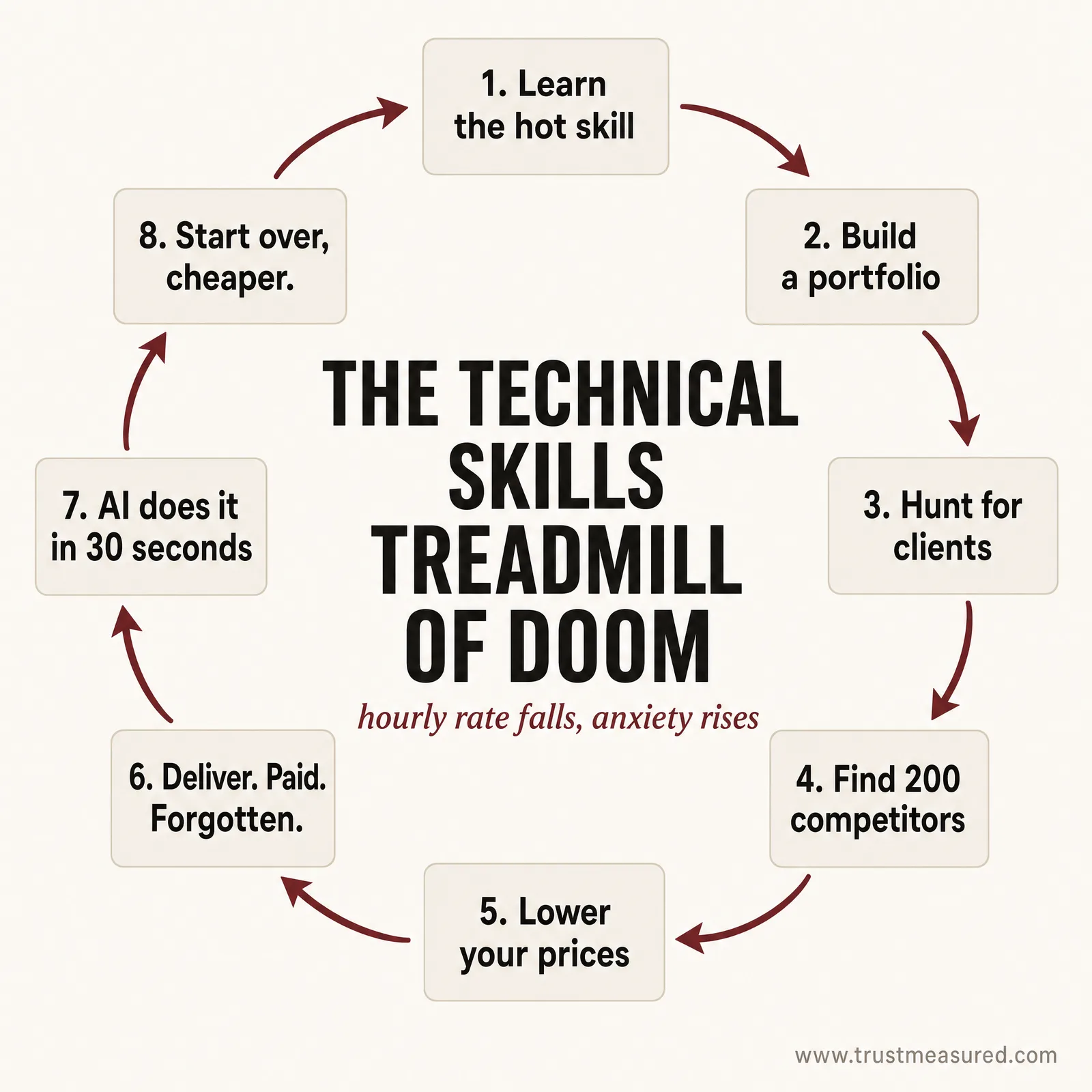 The Technical Skills Treadmill of Doom. Every step feels productive. The loop is the trap.
The treadmill has a design flaw: it optimizes everything about your work except the only part your clients can actually see.
What that flaw means, and why it cost me that client, is the rest of this article. The explanation needs a pizza company that called its own product cardboard, two economists from the 1970s, and the three judgments every client silently makes about you.
The company that insulted its own pizza
In December 2009, Domino's Pizza bought national television time in the United States and used it to broadcast focus-group footage of customers tearing its product apart.
One customer said the crust tasted like cardboard. Another said the sauce tasted like ketchup. Then Patrick Doyle, the company's incoming chief executive, appeared on camera, agreed with them, apologized, and promised to rebuild the recipe from scratch.1
By every conventional rule of marketing this was suicide. You do not tell the world your product is bad. You tell the world it is wonderful, louder than the other guy.
In the first quarter of 2010, Domino's same-store sales rose 14.3 percent, one of the largest quarterly jumps a major fast-food chain had ever reported.2
The comfortable explanation is that the new recipe was better, and it was. But chains improve recipes constantly, quietly, and nobody's sales move fourteen percent in a quarter because of oregano. Something else had moved.
A company willing to stand up in public and say our product was bad has just demonstrated, at enormous cost, that its words mean something. So when the same company says it is good now, that sentence carries weight no ordinary advertisement can buy.
People were not buying the new pizza. They were buying the believability of the people who made it.
Your clients are doing the same thing with you, to a degree that is uncomfortable to accept if you have spent your life mastering a craft. To see why, you need to meet two economists.
The thing you sell that nobody can judge
In 1970, the economist Phillip Nelson pointed out that the things we buy fall into categories, depending on when we can judge them.3
- Search goods you can judge before buying. Sit on the chair. Try on the jacket.
- Experience goods you can judge after. You know whether the meal was good once you have eaten it.
- Credence goods you cannot properly judge even after you have bought them. Surgery. Legal advice. An audit. A marketing strategy. The architecture of your software.4
That third category, named by the economists Michael Darby and Edi Karni in 1973, is the strange one. Did the surgeon do a good job? You healed, but perhaps you would have healed anyway. Was the contract airtight? Ask me again in ten years, if it is ever tested at all.
Now the uncomfortable part. Nearly everything a professional sells lives in this third category, and one feature of it changes everything: your client cannot evaluate your work. Not will not. Cannot. The expertise required to judge it is the very expertise they hired you to supply.
So they grade something else. They grade what they can see:
- Did you do what you said you would do, by the day you said you would do it?
- Did they understand, at every moment, what was happening and what would happen next?
- Did news, especially bad news, reach them from you first, or have to be dragged out of you?
- Did the things you sent feel written for them, or could they have been sent to anyone?
This is the proxy problem: when people cannot measure what matters, they measure what they can see, and treat it as a stand-in for everything they cannot.
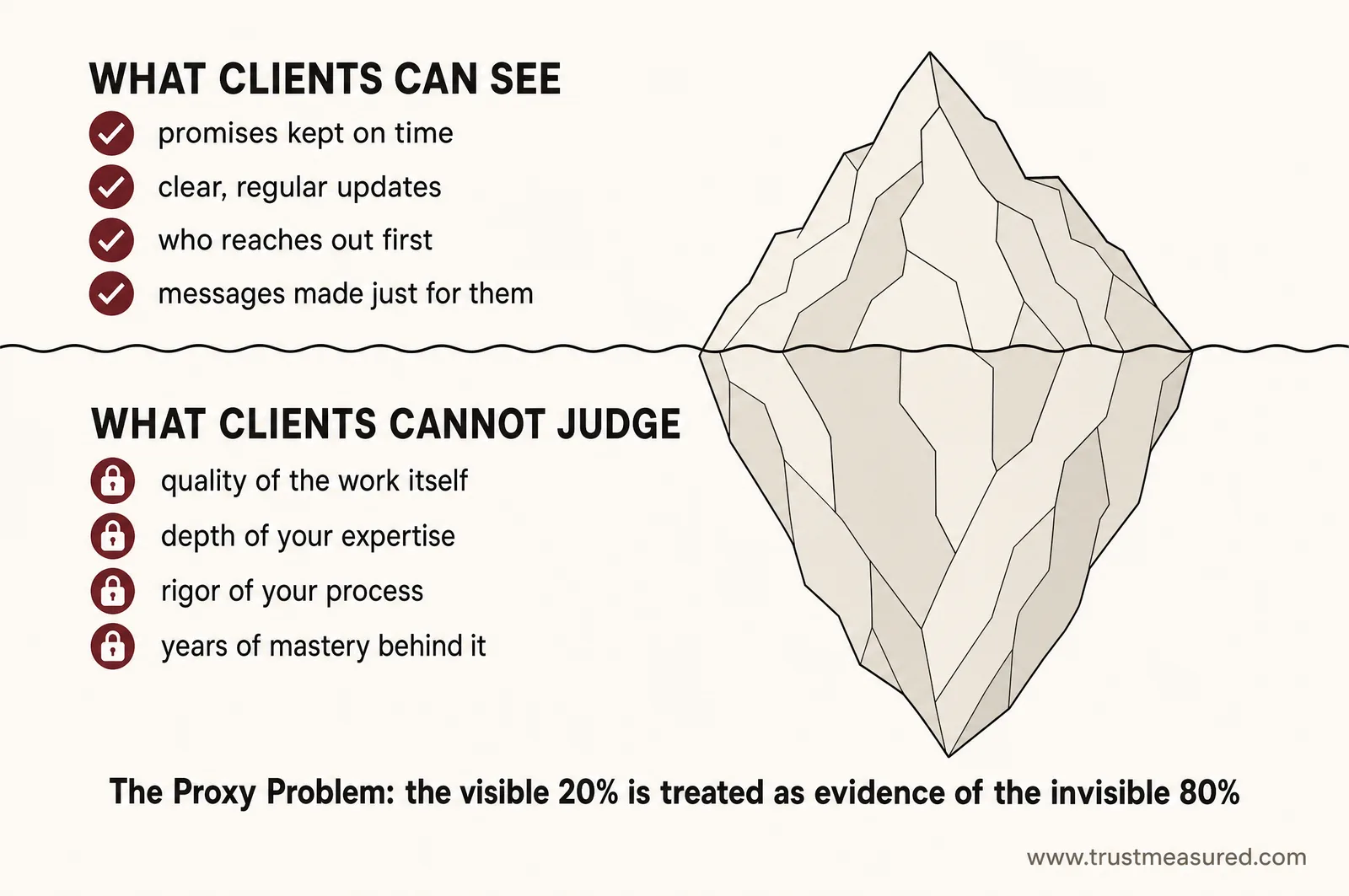 The Proxy Problem. Clients judge the visible and infer the invisible.
A clear weekly update becomes evidence that the work itself is rigorous. A deadline that slips in silence becomes evidence that it might not be.
You may object that this is unfair, and you would be right. You also do it yourself. You chose your dentist for her calm explanations and for the way her receptionist remembers your name. Her actual clinical technique you are no more equipped to judge than your clients are to judge yours.
Which brings me back to that email in January 2016. My colleague had not beaten me at the work. He had beaten me at the evidence of the work. I was buried in the deliverables, certain their quality would speak for itself.
Quality does not speak. It sits invisible inside a credence good, waiting for an expert who is never coming, while the client reads the only signals he can actually read. My client had not been foolish. He had been paying attention.
What better evidence actually looks like
The uncomfortable news is that clients grade the visible. The useful news is that the visible is the cheapest thing you own to change. Three examples, each of which takes minutes.
The status update. Most updates are reassurance, which carries no information and therefore no evidence.
Weak: "Hi — just checking in. Things are progressing well, let me know if you need anything."
Better: "Done this week: the migration script and the staging deploy. Next: data validation, finished Thursday. I need the vendor login from you by Tuesday, or Thursday slips to Monday. Next update Friday."
The second one is not warmer, longer, or more polished. It is checkable — and a client who can check you is a client who can stop worrying about you.
The proposal. A phase list is a price tag. A proposal earns trust when it names what breaks.
Weak: "Phase 1 — Discovery (2 weeks)."
Better: "Phase 1 — Discovery, two weeks, ending with a written findings memo you can circulate. This assumes we get four stakeholder interviews in week one; if we get two, discovery runs three weeks and I will tell you on day five, not at the end."
Stating the condition under which your own estimate fails is expensive to say and almost impossible to fake. That is precisely why it lands.
Bad news. The single highest-leverage habit in this article: whatever has gone wrong, they hear it from you, the same day, with a recovery plan already attached. Bad news delivered early is evidence of control. The same news delivered late is evidence that you were hoping they would not notice — and only one of those is recoverable.
The indifference number
If clients judge the visible, what are they looking for in it? The research on customer defection gives an answer most providers find hard to believe.
Work by the supply-chain researcher John Gattorna puts a number on it: 68 percent of customers who leave a provider do so because of perceived indifference. They came to believe the provider did not care about them.5
- Not price. Price explains only a small fraction of defections.
- Not failure. In most of these cases the work itself was perfectly adequate.
- Missing: evidence of caring. The one deliverable that was never on the invoice.
The word that should keep you up at night is perceived. Most professionals who lose clients this way did care, often deeply. They cared invisibly, heads down in the work, trusting it to speak for itself.
Under the proxy problem, invisible caring and genuine indifference produce identical evidence. To your client, they are the same thing.
And the margin for error is thin. When PwC surveyed fifteen thousand consumers, 32 percent said they would walk away from a brand they loved after a single bad experience.6 Loyalty buys forgiveness, but the account is shallow — and notice what drains it. Not bad output. A bad experience of you.
Three judgments, and the two a machine cannot win
In 1995, three management scientists — Roger Mayer, James Davis, and David Schoorman — published the model of trust that the field still stands on today.7 Stripped of jargon, it says that when we decide whether to trust someone, we score them on three things:
- Ability. Can they do it?
- Benevolence. Are they on my side, beyond what they are paid for?
- Integrity. Will they keep their word when keeping it costs them?
And real trust, the model insists, only exists where something is at risk. To trust is to hand someone the power to hurt you, and to bet they will not use it.
Now hold artificial intelligence up against those three judgments, one at a time.
Ability is lost. Concede it now and you will save yourself years of anxiety. The machines have ability, and on more tasks every year they have more of it than you. If trust were ability alone, your career would be over.
But look at the other two. Benevolence is the belief that someone is on your side, and being on a side requires being a someone. A language model can produce caring sentences all day. It cannot care whose interests those sentences serve. Integrity is the willingness to keep your word at a cost, and a cost requires having something to lose. A machine has no name to stake, no reputation to protect, no relationship it would grieve.
When the system goes down at eleven at night before your client's board meeting, your client does not want a tool that generates output. He wants a person who picks up the phone and says, I have got it. And he wants the sentence to be true because a specific human being's name is attached to it.
Ability can be automated. Accountability cannot, because accountability is precisely the thing a someone does.
The two curves
Everything here fits on one mental graph.
Draw the value of technical ability over time. For a large and growing class of work it is a falling curve: a skill that can be fully written down can be reproduced, supply expands, and the price slides toward the cost of running the machine. It happened to typesetting, to translation, to stock photography, and to a meaningful share of routine code.
Two honest qualifications. This is not universal — skills that require physical presence, licensed accountability, or judgement under genuine uncertainty have held their value, and some have gained. And it is a claim about price under competition, not about the worth of expertise: your ability is what makes you safe to hire at all. What is falling is your ability to be paid a premium for it alone.
Now draw the value of earned trust. It is a rising curve, for three structural reasons:
- Trust compounds. Every promise you keep raises the credibility, and therefore the value, of the next one you make.
- Trust cannot be transferred. A competitor can copy your service, your pricing, even your proposals. Your history with your client is stored in the client.
- Trust is getting scarcer. The more of the economy gets automated, the rarer and more valuable a genuinely accountable human becomes.
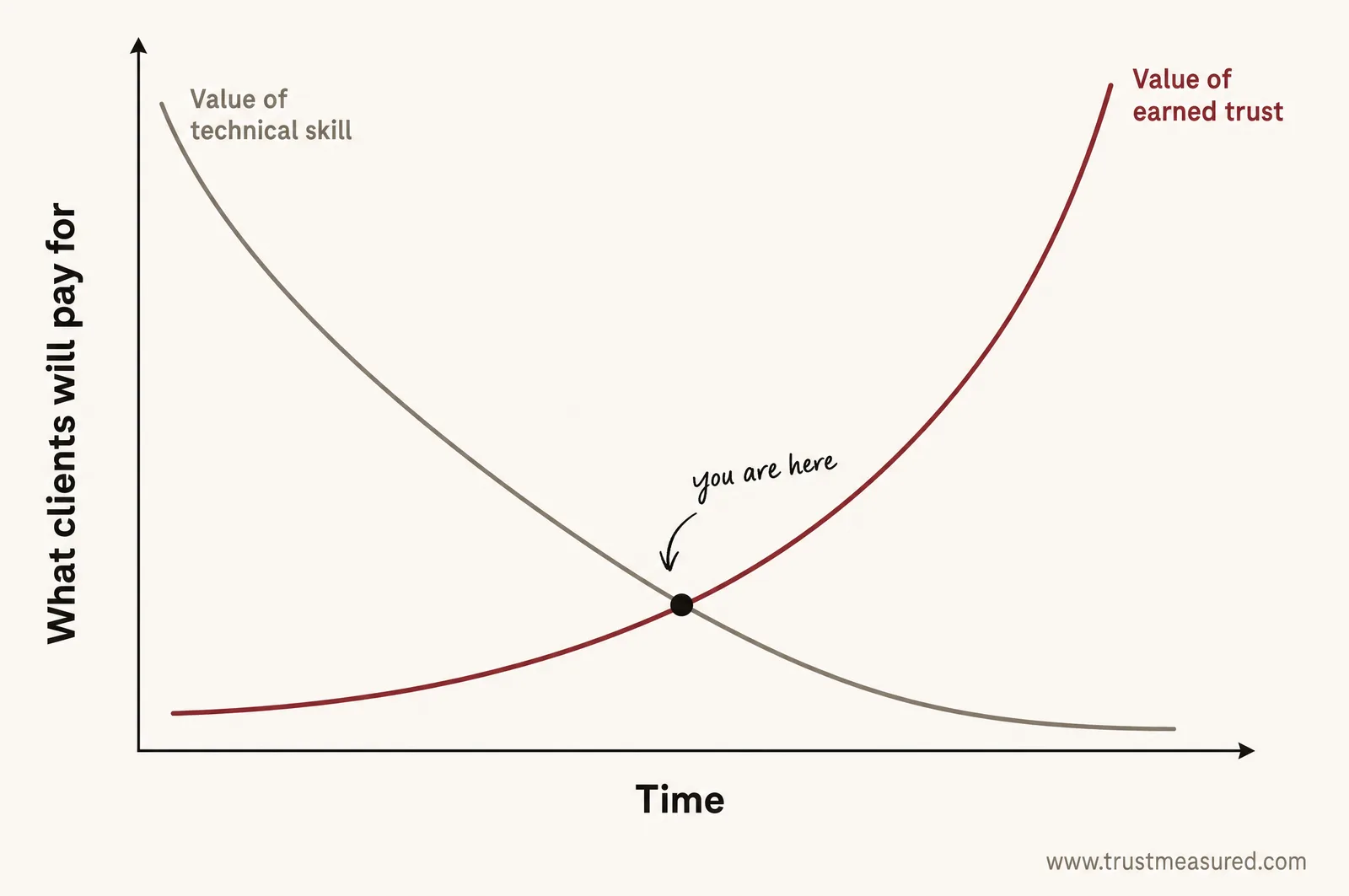 The Two Curves. Skill value commoditizes. Trust value compounds.
You are standing on both curves at once. Every professional is. The only strategic question is which curve your business is built on.
Do this now: find your trust surface
10 minutes.
- Write down the three deliverables that account for most of what clients pay you for.
- Against each, answer honestly: could an AI tool, or a competitor at half my price, produce 80 percent of this quality today?
- Cross out every yes.
What survives is your trust surface: the judgment calls, the accountability, the being known, the relationship itself. The part of your value that sits on the rising curve.
If the surviving list is short, you are in the majority, and at least you now know exactly what the work ahead of you is. The job from here is to make that surface so large, and so deliberately maintained, that everything you crossed out becomes the cheapest thing your clients get from you.
Because my client in 2016 was never buying my engineering. He was buying the certainty that someone would take care of him, and a man with weaker skills sold it to him first.
The next step is turning that certainty into a number.
Next: Can trust be measured? — the four-variable equation that scores any client relationship from 0 to 100.
References
-
Horovitz B. Domino's delivers change in its core pizza recipe. USA Today. 2009 Dec 16. ↩
-
Domino's Pizza, Inc. First quarter 2010 financial results [press release]. Ann Arbor (MI); 2010 May 4. ↩
-
Nelson P. Information and consumer behavior. J Polit Econ. 1970;78(2):311-29. ↩
-
Darby MR, Karni E. Free competition and the optimal amount of fraud. J Law Econ. 1973;16(1):67-88. ↩
-
Gattorna J. Living supply chains. Harlow: Financial Times Prentice Hall; 2006. ↩
-
PwC. Experience is everything: here's how to get it right. Consumer Intelligence Series; 2018. ↩
-
Mayer RC, Davis JH, Schoorman FD. An integrative model of organizational trust. Acad Manage Rev. 1995;20(3):709-34. ↩
The whole system, not just the argument
These essays are the opening chapters. The complete book adds the Resonance Pathway, the monthly dashboard and the 90-day plan that installs all of it, with two bonus guides, for $7.
See what is inside Trust Measured